The plant head walks into the finance review meeting. He wants to buy a new production monitoring system. The CFO looks up and asks one question:
“Is this CapEx or OpEx?”
It sounds like an accounting question. But it determines whether the purchase goes through this quarter or gets pushed to next year’s capital budget. It affects cash flow, tax deductions, and which approval chain it enters. Getting this wrong means delays or worse, the wrong decision entirely.
Here’s a clear breakdown of CapEx vs OpEx, what they mean, how they differ, and how to decide which model works better for your factory.
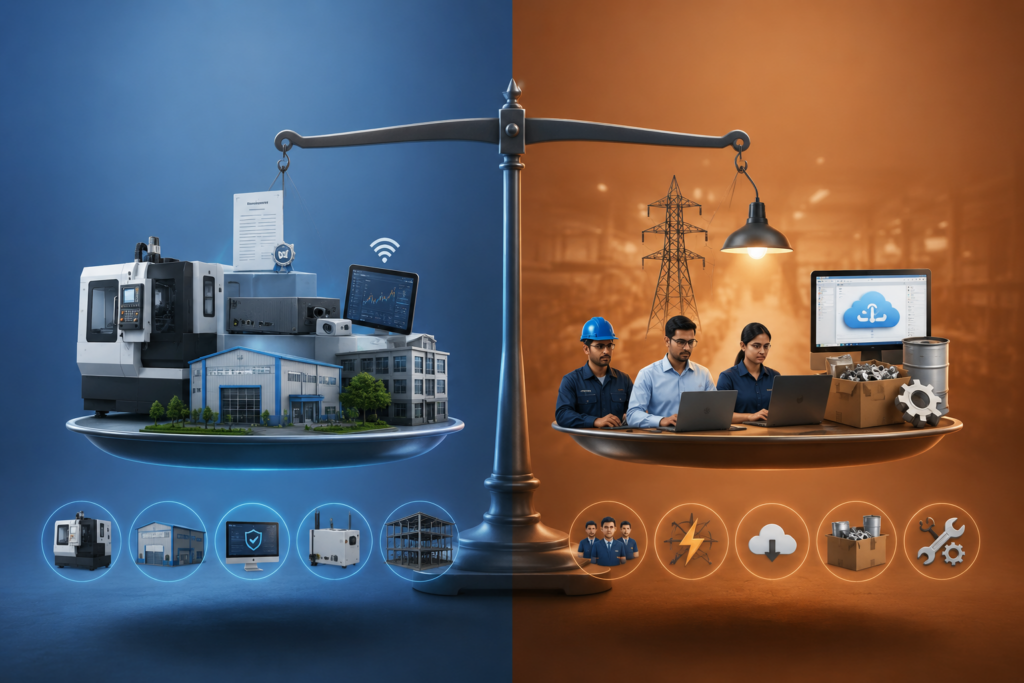
- CapEx (Capital Expenditure) = money spent on long-term assets like machines, buildings, and perpetual software licenses
- OpEx (Operating Expenditure) = ongoing costs to run the business, salaries, rent, utilities, SaaS subscriptions
- CapEx is depreciated over time; OpEx is fully deducted in the year it occurs
- Modern manufacturing software like Leanworx is OpEx, no upfront capital investment, no IT infrastructure needed
What you’ll learn:
CapEx and OpEx defined simply
Before getting into the differences, here’s what each term actually means:
Capital Expenditure
Money spent on acquiring or improving long-term assets — things your business will use for more than one year.
- CNC machines, VMCs, lathes
- Factory buildings and land
- Perpetual software licenses
- IoT hardware and sensors
- Major infrastructure upgrades
Operating Expenditure
Day-to-day recurring expenses that keep your business operations running smoothly.
- Operator and staff salaries
- Electricity and utilities
- SaaS software subscriptions
- Raw materials and consumables
- Machine maintenance and repairs
Simple test: Ask yourself — “Will I use this for more than a year, and does it create or improve a long-term asset?” If yes, it’s probably CapEx. If it’s a recurring cost to keep things running, it’s OpEx.
Key differences between CapEx and OpEx
| Factor | CapEx | OpEx |
|---|---|---|
| Nature of expense | Long-term asset investment | Recurring operational cost |
| Accounting treatment | Capitalized on balance sheet | Expensed on income statement |
| Tax deduction timing | Spread over useful life | Fully deducted in current year |
| Cash flow impact | Large upfront outflow | Smaller recurring payments |
| Approval process | Needs capital budget approval | Within operational budget |
| Risk level | Higher long-term commitment | Lower and flexible |
| Flexibility | Low flexibility | High flexibility |
| Balance sheet effect | Increases assets | No balance sheet impact |
CapEx vs OpEx examples in manufacturing
CapEx examples in manufacturing
- Purchasing a new CNC machining centre for ₹40 lakhs — long-term production asset
- Building a new factory shed or expanding an existing one
- Buying land for a new plant
- Installing a new electrical transformer or compressor system
- Purchasing perpetual licenses for ERP software
- Acquiring IoT edge devices or hardware for machine connectivity
- Setting up a new quality inspection lab with equipment
OpEx examples in manufacturing
- Monthly salaries of machine operators, supervisors, and engineers
- Electricity bills for running machines and the facility
- Monthly SaaS subscription for Leanworx production monitoring
- Cutting tool consumption, coolant, and other consumables
- Annual maintenance contract (AMC) for CNC machines
- Factory rent or lease payments
- Raw material purchases for production orders
A machining unit in Coimbatore buys a new VMC for ₹35 lakhs — that’s CapEx. It gets depreciated at 15% per year under the Companies Act. The same factory subscribes to Leanworx at ₹X per month to monitor that VMC in real time — that’s OpEx, fully deductible this financial year.
Same factory. Same machine. Two different expense types — one on the balance sheet, one straight to the P&L.
When to choose CapEx vs OpEx
Choose CapEx when
- You're investing in physical assets you'll use for 5–10+ years
- Your cash flow can absorb a large upfront payment
- Complete ownership and data control is important
- You want to build asset value on your balance sheet
- Accelerated depreciation benefits apply to the asset
- You're in a high-tax year and want to reduce taxable income over time
Choose OpEx when
- You want to preserve working capital for core operations
- The technology changes fast and you need flexibility to upgrade
- You want to avoid large capital approval processes
- You need immediate tax deduction in the current year
- You're an SME or startup with limited balance sheet capacity
- Scalability matters — you want to pay as you grow

Manufacturing software is CapEx or OpEx?
This is one of the most common questions factory managers ask today — and the answer has shifted significantly in the last decade.
Traditionally, manufacturing software (ERP, MES, production monitoring) was sold as perpetual licenses with large upfront costs. That made it CapEx. A factory would pay ₹20–50 lakhs upfront, deploy on-premise servers, and maintain it for 7–10 years.
Today, almost all modern manufacturing software is sold as SaaS — a monthly or annual subscription. That makes it OpEx.
Moving from CapEx software to OpEx SaaS means no large upfront investment, no server infrastructure, no IT team required, and no multi-year depreciation cycles. You subscribe, connect, and get value from day one. The cost goes directly to P&L and is fully deductible this year.
| Factor | Traditional Software (CapEx) | SaaS Software (OpEx) |
|---|---|---|
| Upfront cost | High — ₹10–50L+ | Zero or minimal |
| Deployment time | Months | Days |
| IT infrastructure | On-premise servers required | Cloud-based, no hardware |
| Upgrades | Manual, costly, infrequent | Automatic, included |
| Tax treatment | Depreciated over useful life | Fully deductible this year |
| Flexibility | Locked in for years | Cancel or scale anytime |
| Budget approval | Capital budget — senior sign-off | Operational budget — faster |
CapEx vs OpEx in India
Smart Manufacturing Context
Why the CapEx vs OpEx decision is especially important for Indian manufacturers
Indian SME manufacturers face unique financial constraints that make the CapEx vs OpEx choice more consequential than in mature markets. Here’s what’s changing:
Most Indian job shops and component manufacturers operate with tight working capital — large CapEx commitments can restrict growth flexibility
PLI schemes and government incentives are encouraging investment in new machinery — making CapEx more attractive when grants or subsidies offset the upfront cost
Export customers in auto and aerospace increasingly require digital traceability — but want it implemented quickly, favouring OpEx SaaS solutions
Indian SMEs are increasingly preferring OpEx models for technology to avoid the IT infrastructure burden of on-premise deployments
Accelerated depreciation (40% in Year 1) under Section 32 makes CapEx machinery investments more tax-efficient for profitable factories
SaaS manufacturing software at ₹X/month is often easier to approve through operational budgets than a ₹30L CapEx line item
Try Leanworx for Free.
For 1 Machine
Get live reports, real-time dashboards, mobile alerts, and full production visibility exactly like our paid customers.
FAQs:
1. What is the difference between CapEx and OpEx?
2. Is manufacturing software CapEx or OpEx?
3. What are examples of CapEx in manufacturing?
Common CapEx examples include: purchasing CNC machines, VMCs, or lathes; building or expanding a factory; buying land; acquiring perpetual ERP or MES licenses; installing IoT edge hardware or sensors; upgrading electrical infrastructure. These are long-term asset investments depreciated over their useful life.