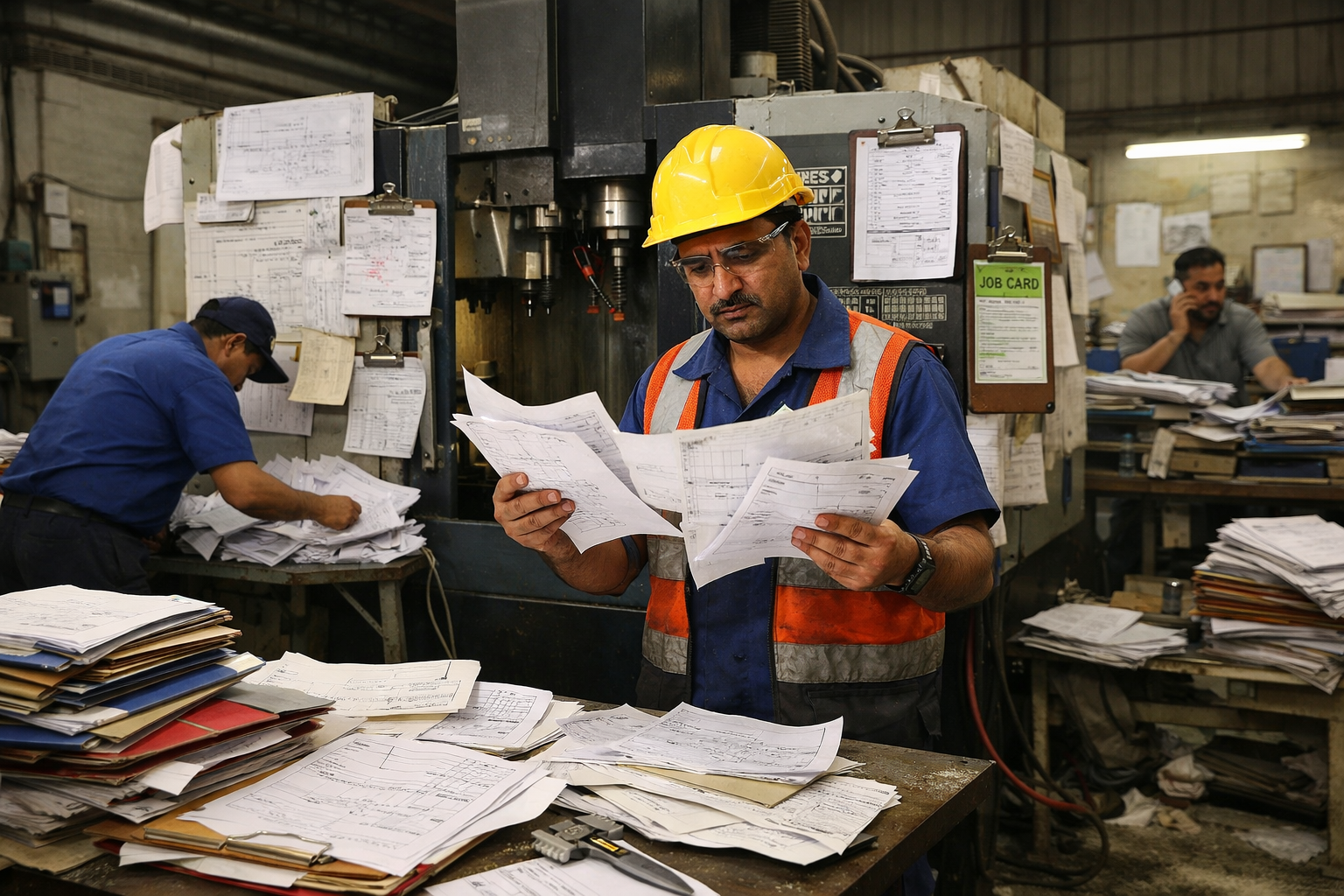
Your operator just stopped the machine to find a drawing. It’s not on the table. It’s not in the folder. Someone took it to the inspection desk three hours ago.
That’s three minutes gone. Multiply it by 12 operators, three shifts, 250 working days.
You just lost over 450 hours of production time — to paper.
- A single manufactured part can involve 5 to 12 paper documents: drawings, job cards, inspection sheets, NC programs, tool lists, and more.
- Operators waste 10–20 minutes per shift hunting for, filling in, or waiting on paper documents.
- Paper-based records are always late, often incomplete, and impossible to trace in real time.
- When a quality rejection occurs, paper trails make root cause analysis take days instead of minutes.
- Planners cannot see live production status when the only record is a job card sitting on a machine.
- Leanworx eliminates paper from the shopfloor by digitizing job cards, drawings, NC programs, inspection checklists, and production logs — in one system, accessible on any screen.
- Shopfloors that went paperless with Leanworx reduced documentation-related delays by over 60% within the first quarter.
What you’ll learn:
- Why paper is still the biggest hidden bottleneck in manufacturing
- What documents are actually multiplying on your shopfloor — and why
- How paper mismanagement hits operators, planners, and management differently
- Why digitalizing documents without a system still fails
- How Leanworx makes your shopfloor completely paperless — and what that looks like in practice
Why Is Paper Still Causing Problems on Modern Shopfloors?
Walk into almost any mid-size manufacturing plant and you will find the same scene: a job traveler tucked under a machine clamp, a drawing with handwritten corrections on the margins, an inspection sheet that nobody can find, and a planner calling the shopfloor to ask what stage Order #374 is at.
This is not because the people are careless. It is because paper was never designed to carry the information load that a modern manufacturing shopfloor demands.
A single part — one part — can require all of the following before it moves to the next stage:
- Engineering drawing (and potentially multiple revisions)
- Job card or route card
- NC program printout
- Tool setup sheet
- First article inspection form
- In-process inspection checklist
- Rejection note (if applicable)
- Material traceability document
That is eight documents. For one part. When you are running 15 part numbers across 20 machines on three shifts, the paper burden becomes physically unmanageable.
And yet most shopfloors treat this as a logistics problem — more folders, better labels, dedicated file trolleys. The problem is not how you organize the paper. The problem is the paper itself.
What Actually Happens When Operators Have to Manage Multiple Documents?
How Does Paper Slow Down Operators at the Machine?
An operator starting a new job needs the right drawing revision, the correct NC program, and the setup sheet — all at the same time, before the first chip falls.
In a paper system, this means walking to the planner’s desk, finding the job packet, confirming the revision is current, and hoping the NC program printout hasn’t been edited by someone else since it was printed. If any of those steps hit a snag, the machine waits.
This is not a one-off event. It happens at every job changeover, on every machine, every shift. Operators are not slow — they are navigating a system that was not built for speed.
Why Do Planners Lose Visibility When Production Runs on Paper?
A planner’s job is to know where every order stands at any given moment. In a paper-based shopfloor, that is structurally impossible.
The job card is with the operator. The inspection sheet is at the quality desk. The rejection note hasn’t been written yet. The planner calls the supervisor. The supervisor walks to the machine. Fifteen minutes later, someone knows the status of one order.
Multiply this by 30 open orders and you understand why production planning in paper-heavy factories is mostly reactive — chasing fires instead of preventing them.
Why Can't Management Make Decisions With Paper-Based Production Data?
By the time shopfloor data reaches management in a paper-based system, it is already history.
End-of-shift summaries are filled in from memory. Daily production reports are aggregated from those summaries. Weekly reviews happen based on data that is five to seven days old. Decisions get made on yesterday’s problems, not today’s.
If a quality rejection rate is quietly climbing across a particular machine, management will not see it for a week. If an operator is consistently falling short of standard cycle time, nobody connects the dots until the monthly appraisal — if at all.
Does Going Digital Just Mean Scanning Documents and Storing PDFs?
This is the mistake that most factories make when they try to solve the paper problem.
They scan drawings and store them on a shared drive. They move job cards to Excel. They email NC programs instead of printing them. And within three months, they are back to the same chaos — except now it is digital chaos, which is actually harder to navigate because nobody knows which folder version is current.
Digitizing documents without a system that connects them to production in real time solves exactly nothing. You have traded a physical paper pile for a digital one.
The question is not “how do we store documents better?” The question is: “How does the right document reach the right operator at the right machine at the right moment — without anyone having to find it, carry it, or guess whether it is the current revision?”
Those are two completely different problems. One is a storage problem. The other is a workflow problem. And only solving the workflow problem actually eliminates paper from your shopfloor.
How Does Leanworx Eliminate Paper from the Shopfloor?
Leanworx is not a document management system. It is a shopfloor intelligence platform — and paperless manufacturing is one of the core outcomes it delivers, because every piece of information an operator, planner, or quality engineer needs is built into the production workflow itself.
Here is what this looks like in practice.
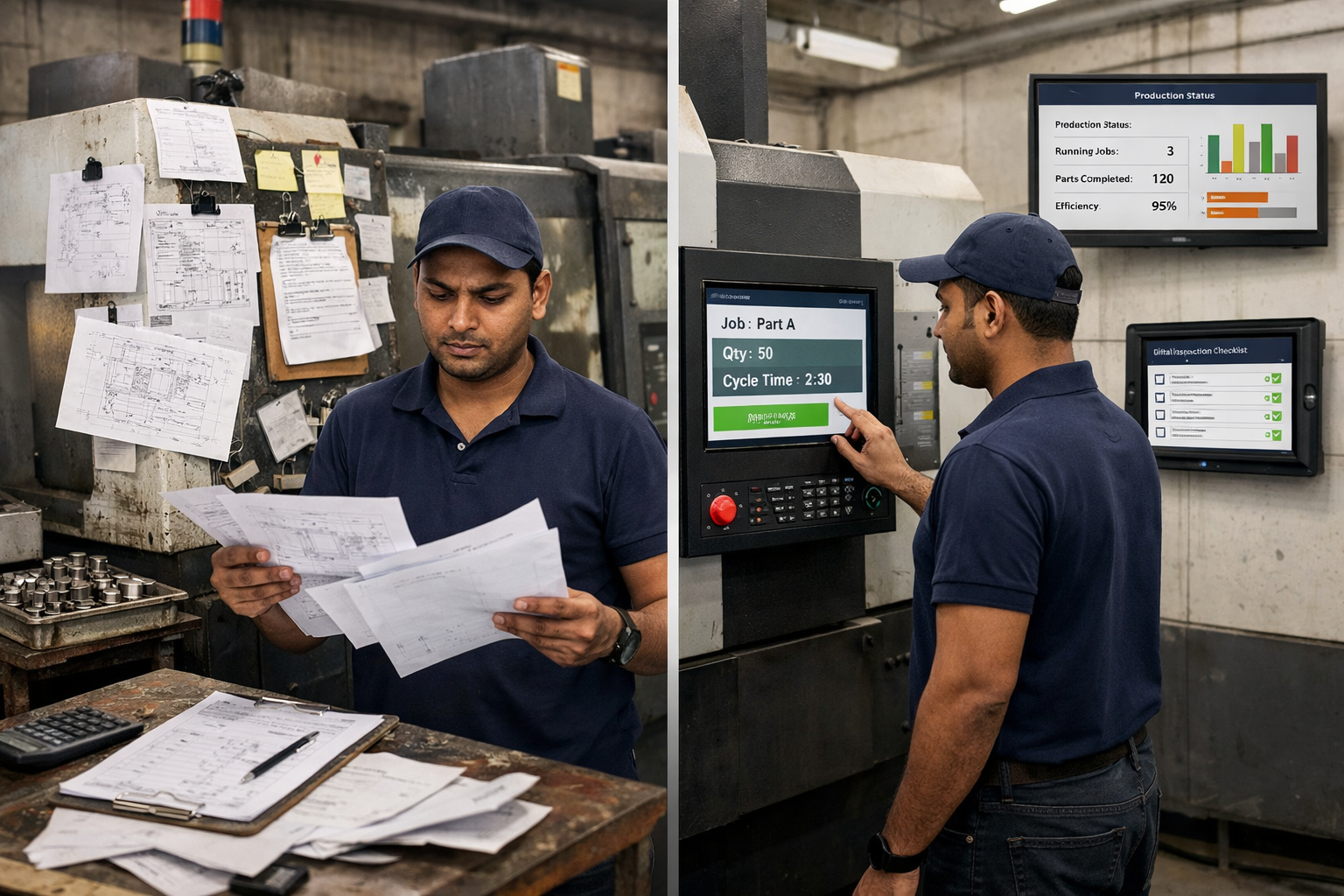
Job cards go digital. When a new production order is released, the job card is created in Leanworx and pushed to the relevant machine terminal automatically. The operator sees the job, the quantity, and the target cycle time — without a single piece of paper changing hands.
Drawings and revision control are built in. Engineering drawings are attached to the part master in Leanworx. When an operator opens a job, they see the current revision — not the one that was printed six weeks ago and has since been superseded. Revision changes propagate instantly. No more “wrong drawing” rejections.
NC programs are linked to jobs. The correct program is attached to the job card, so the operator and the machine setter are always working from the same file. No printouts. No transcription errors. No version mismatches.
Inspection checklists run on the system. First article inspection, in-process checks, and final inspection forms are all digital, filled in at the machine or inspection station, and automatically linked to the job. When there is a rejection, the data is already in the system — traceable to the operator, the machine, the shift, and the part revision.
Production logs write themselves. Because Leanworx connects directly to the machine, every cycle is captured automatically. Operators do not fill in production logs at the end of the shift. The machine already did it.
Planners see everything live. Instead of calling the shopfloor to ask where an order is, planners log into Leanworx and see real-time job status across every machine — quantity produced, remaining quantity, current operator, and any quality flags. No chasing. No guessing.
What Changes on the Shopfloor When Paper Is Eliminated?
The first thing people expect when they go paperless is efficiency. What they do not expect is how much it changes accountability.
When every job card is digital and every production log is machine-generated, there is no ambiguity about what happened, when it happened, and who was responsible. Operators cannot round up their numbers. Supervisors cannot overlook a downtime event. Quality rejections cannot disappear between the machine and the quality desk.
This transparency is uncomfortable for about two weeks. After that, it becomes the foundation of a shopfloor that actually runs on data.
One gear manufacturing plant that moved to Leanworx reported that their planners — who previously spent roughly two hours per shift chasing status updates — reclaimed that time entirely within the first month. The work did not disappear. The running around did.
For management, the shift is even more significant. Instead of reviewing last week’s numbers in a Monday morning meeting, they are looking at live dashboards. Trend lines are visible before they become crises. Decisions happen on current information, not historical reconstructions.
How Do You Move From a Paper-Heavy Shopfloor to a Paperless One Without Disrupting Production?
The transition does not require a factory shutdown or a six-month IT implementation. Leanworx is designed to be deployed on existing machines — CNCs, VMCs, legacy equipment — without hardware overhaul.
The practical sequence looks like this:
Start with one machine or one cell. Digitize the job cards and production logs for that section first. Measure the time saved in the first two weeks. Use that data internally to build buy-in from supervisors and operators.
Attach drawings to the part master progressively. You do not have to upload every drawing on day one. Build the digital library as new jobs come through. Within 60 days, most active part numbers will be covered.
Move inspection checklists digital next. This is where quality teams typically feel the biggest immediate relief — no more chasing paper forms, no more transcription errors into the quality register.
Let the production logs retire themselves. Once machine data is capturing output automatically, the end-of-shift logbook becomes redundant. Operators notice this within the first week. The shift from filling in a log to simply doing the work is not a small thing — it is one of the most tangible morale improvements that comes with going paperless.
Give planners the live view. Once job cards and production data are live in Leanworx, planners stop calling the shopfloor for status. This alone changes the working relationship between planning and production more than any organizational intervention ever has.
Try Leanworx for Free.
For 1 Machine
Get live reports, real-time dashboards, mobile alerts, and full production visibility exactly like our paid customers.
FAQs:
1. How many documents are typically used per part in manufacturing?
It varies by industry and process complexity, but a typical machined component can involve 5 to 12 documents: engineering drawings, route cards, NC programs, setup sheets, inspection forms, and traceability records. On a shopfloor running multiple part numbers across shifts, this paper load becomes a genuine operational bottleneck.
2. What is paperless manufacturing and how does it work?
Paperless manufacturing means replacing physical documents — job cards, drawings, inspection sheets, production logs — with digital workflows that are linked directly to production orders and machine activity. Instead of paper traveling between the planner, operator, and quality desk, information is accessed on terminals or tablets at the point of use, in real time.
3. Will operators resist switching from paper to digital on the shopfloor?
Initial resistance is common, but it fades quickly once operators realize they no longer have to hunt for documents, fill in logs at the end of the shift, or deal with wrong-revision drawings. The biggest adoption driver is not training — it is showing operators that the system makes their own work easier, not just management’s visibility better.
4. How does going paperless improve quality management?
When inspection checklists are digital and linked to specific jobs and operators, rejection data is captured in real time and is immediately traceable. Root cause analysis that previously took days — because someone had to dig through paper records — now takes minutes. Trend identification improves significantly when quality data is structured, searchable, and live.
5. Can Leanworx work with our existing machines for paperless manufacturing?
Yes. Leanworx connects to CNCs, VMCs, conventional machines, and legacy equipment without requiring new hardware or machine replacements. The system captures machine signals directly and overlays digital job workflows on top of your existing production process — which is why most shopfloors see results within weeks, not months.