Your machines are running. But are they producing or just burning power?
In most manufacturing shopfloors, 20–40% of energy is consumed by machines that are idle, waiting, or running well below capacity. And nobody sees it because nobody is measuring it.
Everything you need to know — in 60 seconds:
- Most shopfloors have no machine-wise energy visibility; energy bills are a single monthly number with no breakdown.
- Idle machines, compressed air leaks, and unplanned downtime are the three biggest drivers of invisible energy waste.
- Energy consumption in manufacturing is tightly linked to OEE — a machine with low utilisation is a machine consuming energy without producing value.
- Tracking energy at the machine and part level reveals which jobs, shifts, and operators are the worst offenders.
- Leanworx monitors machine-wise and part-wise energy consumption in real time — hourly, daily, and across long-term trends — so you can act on data, not guesswork.
- Shopfloors that eliminated idle machine time with real-time monitoring reduced energy consumption significantly within the first quarter.
What you’ll learn:
Why Is Energy Consumption in Shopfloor So Hard to Control?
Walk into any mid-size manufacturing plant and ask the production head: “Which machine consumes the most energy per part?”
Most cannot answer that question.
They know the monthly electricity bill. They may know roughly how much the compressor costs to run. But machine-wise energy breakdowns — by shift, by part number, by operator — simply do not exist in most shopfloors.
This is not a technology problem. It is a visibility problem.
When energy data is invisible, every decision is based on assumptions. Maintenance schedules are not tuned to energy peaks. Production planning does not account for which jobs burn the most power. Nobody knows whether the night shift is consuming 30% more energy per part than the day shift — even if it consistently does.
The first step to reducing energy consumption in the shopfloor is not buying new equipment. It is understanding where power is actually going.
Where Does Energy Actually Get Wasted on a Shopfloor?
Before you can fix anything, you need to understand the anatomy of shopfloor energy waste. It typically falls into three categories.
1. Idle Machines Running at Full Power
A CNC machine sitting between jobs, waiting for the next job card, setup instructions, or material — is still drawing power. Spindles may be off, but coolant pumps, servo drives, and control systems continue consuming electricity.
In a 3-shift operation running 20 machines, idle time of even 15 minutes per machine per shift adds up to hundreds of machine-hours per month — all drawing energy, none producing parts.
This is the most correctable form of waste on the shopfloor. But it requires knowing when machines are idle, for how long, and why. Without a monitoring system, it remains invisible.
2. Compressed Air Leaks
Compressed air is one of the most energy-intensive utilities in any manufacturing facility. And leaks in compressed air systems are notoriously difficult to detect without specialised tooling.
A single undetected leak can waste energy continuously across every shift, every day. Multiply this across an aging pipe network and you have a permanent, invisible drain on your energy bill.
Proper maintenance scheduling — driven by real machine data — can significantly reduce this category of loss.
3. Unplanned Downtime and Reactive Maintenance
When a machine breaks down unexpectedly, the energy cost is not just the idle time during repair. It is the disruption that follows — overtime to catch up, machines running at higher intensity, schedules pushed into shifts where energy tariffs may be higher.
Unplanned downtime is both a productivity problem and an energy problem. Factories that move from reactive to preventive maintenance find that their energy profiles become significantly more predictable — and lower.
Why OEE and Energy Consumption Are the Same Problem
This connection is underappreciated in most manufacturing discussions about energy efficiency.
OEE — Overall Equipment Effectiveness — measures how productively a machine is being used against its full potential. A machine running at 45% OEE is, in energy terms, consuming near-full power for only 45% productive output. The remaining 55% of its energy draw is either idle consumption or running at non-standard conditions.
Improving OEE is, by definition, improving energy efficiency. Every percentage point of OEE improvement means more parts produced per unit of energy consumed.
This is why energy reduction on the shopfloor is not a sustainability project. It is a productivity project with a lower electricity bill as a byproduct.
The 5 Practical Steps to Reduce Energy Consumption in Shopfloor
Step 1: Measure Machine-Wise Energy in Real Time
You cannot manage what you cannot measure. The first intervention is establishing energy baselines at the machine level — not just the whole facility.
This means knowing: how much energy does Machine #7 consume per shift? Per part? How does that change between operators? Between part numbers? Between planned and unplanned cycles?
Without this data, every energy-saving initiative is a guess.
Step 2: Identify and Eliminate Idle Time
Real-time machine monitoring reveals when machines are running versus idle — down to the minute. When this data is visible, patterns emerge quickly.
Machines waiting for job cards, setup instructions, material delivery, or operator attention are all preventable idle-time events. Once you can see them, you can systematically address each root cause and reduce the hours your equipment draws power without producing output.
Step 3: Schedule Maintenance Before Breakdowns Happen
Preventive maintenance, planned on the basis of actual machine usage data rather than fixed calendar intervals, dramatically reduces unplanned stoppages. This stabilises energy consumption patterns and eliminates the energy-intensive recovery cycles that follow breakdowns.
The goal is not just fewer breakdowns. It is a shopfloor where machines run at consistent utilisation levels — which makes energy planning far more predictable and controllable.
Step 4: Track Energy Per Part, Not Just Per Machine
Part-wise energy tracking reveals something machine-level data cannot: which jobs are the energy outliers.
A part number that consistently takes longer than its standard cycle time is not just a productivity issue — it is consuming more energy per piece than it should. When this data is visible, process engineers can investigate root causes: tooling wear, incorrect parameters, operator variation, or machine condition.
This is where energy reduction connects directly to quality and process improvement — not just utilities management.
Step 5: Align Production Scheduling With Energy Peaks
Once you have shift-wise and machine-wise energy consumption data, production planning can be optimised to avoid concentration of high-energy jobs in peak tariff periods, reduce the number of machines left running between batches, and batch similar jobs to minimise idle time during changeovers.
This is advanced shopfloor management — but it starts with having the data in the first place.
How Leanworx Helps You Reduce Energy Consumption in Shopfloor
Leanworx is a real-time machine monitoring and shopfloor intelligence platform. Energy visibility is one of the core outcomes it delivers — not as an add-on, but built into how the system tracks every machine on your floor.
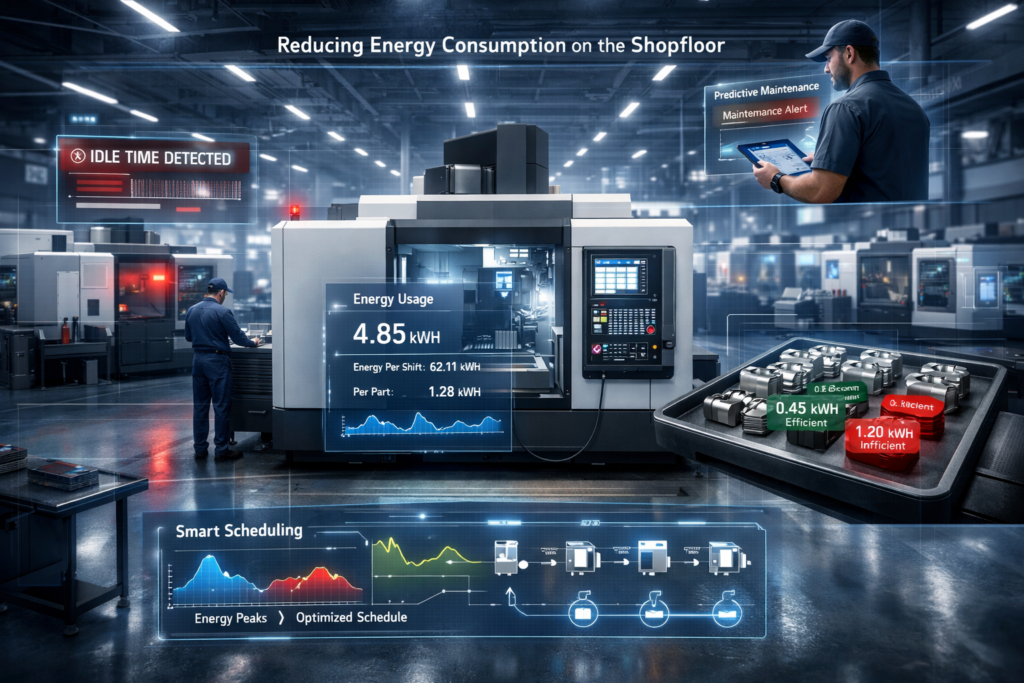
Machine-wise and part-wise energy tracking. Leanworx tracks and reports energy consumption at the machine level and at the part level. You see how much energy each machine draws per shift, per day, and across long-term trends. You also see energy per part produced — so you know exactly which jobs cost more to make than they should.
Idle time detection, automatically. Leanworx connects directly to your machines and detects the moment a machine stops producing — whether it is between jobs, during setup, or due to an unscheduled stop. Every idle event is logged with duration and reason. Planners can see idle time across all machines in real time, without walking the floor.
Downtime monitoring and preventive maintenance. Leanworx captures every downtime event with start time, end time, duration, and reason code. Over time, this data drives maintenance scheduling based on actual machine condition — not calendar assumptions. Fewer surprise breakdowns means fewer energy spikes.
OEE monitoring connected to energy outcomes. Because Leanworx monitors OEE at the machine level, improving OEE and reducing energy waste become the same operational objective. Higher utilisation means more parts per unit of energy — a result that shows up in both your production report and your electricity bill.
Real-time dashboards for production and energy. Management does not have to wait for end-of-shift summaries. Energy consumption patterns, idle time, and downtime data are visible live — enabling faster intervention and better decisions before the shift ends.
What Changes When Energy Is Finally Visible?
The most immediate change is accountability. When operators and supervisors can see idle time and energy data in real time, behaviour changes without any new policy being issued.
Machines do not get left running between shifts. Downtime reasons are logged accurately. Setup time reduces because job information arrives at the machine before the operator does.
One gear manufacturing customer using Leanworx found that real-time monitoring of machine idle time — combined with live production scheduling visibility — allowed planners to restructure job sequencing to cut idle periods between batches. The energy savings were a direct result of visibility, not capital expenditure.
The principle holds across shopfloors of every size: the factories that control their energy bills are the ones that can see, in real time, what their machines are doing — and what they are not.
Try Leanworx for Free.
For 1 Machine
FAQs:
1. What are the biggest sources of energy waste in a manufacturing shopfloor?
The three most common sources are idle machines drawing power between jobs, compressed air system leaks that go undetected across shifts, and unplanned downtime that disrupts production scheduling and drives energy-intensive recovery. In most factories, these three categories together account for 20–40% of total energy consumption — none of which contributes to output.
2. How does machine monitoring help reduce energy consumption in shopfloor?
Machine monitoring gives you real-time visibility into when each machine is running, idle, or down — and for how long. This data reveals idle time patterns that would otherwise stay invisible in end-of-shift logs. When you can see which machines are idle and why, you can address the root causes: delayed job cards, material shortages, waiting for setups. Eliminating idle time directly reduces energy consumed without corresponding output.
3. What is part-wise energy tracking and why does it matter?
Part-wise energy tracking measures how much energy is consumed per unit produced for a specific part number, rather than just totalling machine energy per shift. This reveals which jobs are energy outliers — parts that consistently take longer than standard cycle time consume more energy per piece than they should. When this data is visible, process engineers can investigate root causes such as tooling wear, operator variation, or incorrect machining parameters.
4. Is improving OEE the same as improving energy efficiency?
In practical terms, yes. A machine with low OEE is consuming near-full power while producing significantly below its potential. Every percentage point of OEE improvement means more parts produced per unit of energy drawn. This is why the most effective energy reduction strategies on the shopfloor focus on improving machine utilisation — not just auditing utility bills.
5. Can Leanworx track energy consumption on legacy machines, not just new CNCs?
Yes. Leanworx connects to CNCs, VMCs, conventional machines, and legacy equipment without requiring hardware replacement. The system captures machine signals directly and overlays real-time energy and production data on top of your existing setup. Most shopfloors see meaningful visibility within the first week of deployment — without any production disruption during installation.