A production manager at a mid-size machining unit in Pune gets a call on a Tuesday afternoon. A key automotive customer is threatening to pull the contract. Two deliveries in a row have been late.
The manager walks to the floor. Machines are running. Operators look busy. On paper, everything should be fine.
But there’s no live data. No visibility into which machine lost three hours last week to an unplanned stoppage. No record of which jobs are stuck between operations. Just end-of-shift logs — filled in retrospectively, sometimes guessed.
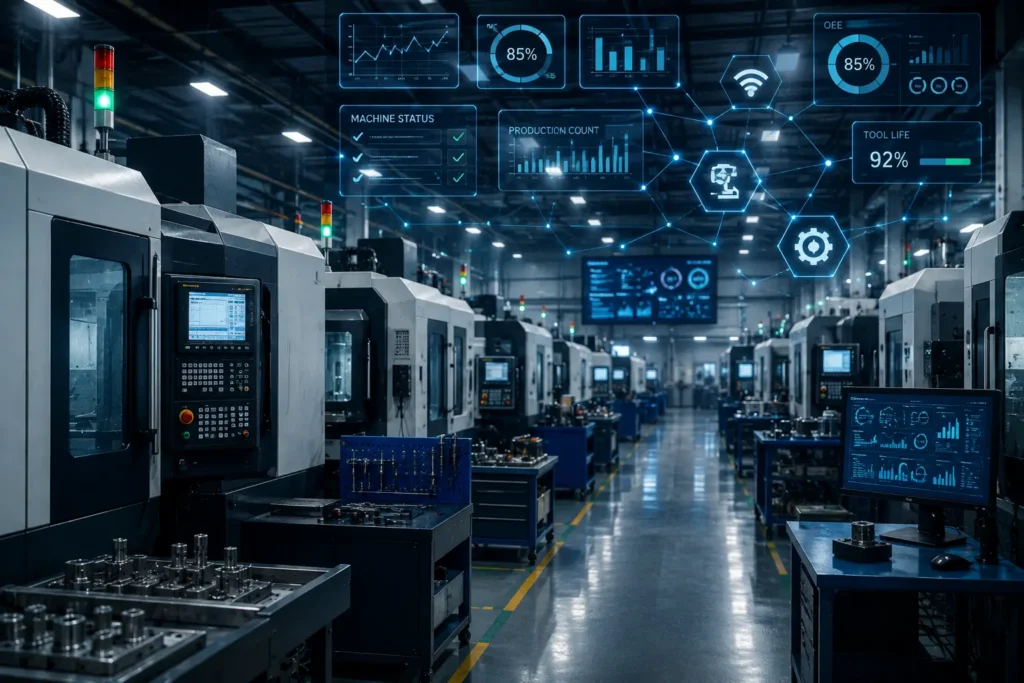
Smart manufacturing is the answer to this exact situation. Not a futuristic concept. A practical tool that gives factory managers the real-time visibility they need to stop firefighting and start controlling.
- Smart manufacturing uses real-time data, IoT sensors, and connected software to monitor and improve production
- It replaces manual reports and guesswork with live shopfloor visibility across machines, jobs, and operators
- Key metrics like OEE, WIP, downtime, and cycle time are tracked automatically — not entered after the shift ends
- Smart manufacturing is Industry 4.0 in practice — applicable to factories of any size, including Indian SMEs
- Factories that adopt it typically see 10–25% OEE improvement and 30%+ reduction in unplanned downtime
What you’ll learn:
What is smart manufacturing?
Smart manufacturing is the use of real-time data, connected machines, IoT sensors, and intelligent software to continuously monitor, analyse, and improve production operations.
In simple terms: it’s what happens when your shopfloor stops being a black box.
Instead of waiting for an end-of-shift report to find out what went wrong, a smart manufacturing system tells you what’s happening right now — which machine is running, which is idle, which job is on track, and which is about to cause a delay.
Core definition : Smart manufacturing = shopfloor data captured automatically + displayed in real time + used to make faster, better decisions. That’s it. Everything else IoT, AI, edge computing is in service of this.
Smart manufacturing is the use of real-time data, connected machines, IoT sensors, and intelligent software to continuously monitor, analyse, and improve production operations.
In simple terms: it’s what happens when your shopfloor stops being a black box.
Instead of waiting for an end-of-shift report to find out what went wrong, a smart manufacturing system tells you what’s happening right now — which machine is running, which is idle, which job is on track, and which is about to cause a delay.
Smart manufacturing and Industry 4.0
Smart manufacturing is the practical application of Industry 4.0 on the shopfloor. To understand why it matters, it helps to understand how manufacturing has evolved:
1. First Industrial Revolution
Steam and water power replaced hand production. Factories replaced home-based manufacturing. Mass production became possible.
2. Second Industrial Revolution
Electrification of factories. Steel making advances. One person operating a machine could produce what dozens once produced by hand.
3. Third Industrial Revolution
Computers and automation took over repetitive tasks. CNC machines, PLCs, and early ERP systems emerged. Productivity increased dramatically.
4. Fourth Industrial Revolution ( Industry 4.0 )
IoT, AI, machine learning, robotics, and real-time data systems connect the physical and digital worlds. Smart manufacturing is what this looks like inside a real factory.
Key technologies that power smart manufacturing
Smart manufacturing isn’t one technology it’s a combination of tools working together. Here’s what each layer does:
1. IIoT Sensor
Attached to machines to capture signals — spindle load, cycle starts, vibration, temperature — and feed them into the software in real time.
2. Edge Computing
Processes machine data locally before sending to the cloud. Enables faster response times and works even with unreliable internet connectivity.
3. MES Software
Manufacturing Execution System manages production orders, tracks job progress, and bridges ERP planning with real shopfloor execution.
4. Real-time OEE
Overall Equipment Effectiveness — availability, performance, quality calculated live per machine, not as a monthly average from a spreadsheet.
5. Cloud analytic & AI
Identifies patterns, predicts failures, surfaces insights, and enables remote visibility for plant heads and management.
6. ERP Integration
Feeds real shopfloor actuals back to SAP, Oracle, or any ERP — so planning, procurement, and finance run on real data, not estimates.

KPIs you must track in smart manufacturing
Overall Equipment Effectiveness (OEE)
OEE measures how effectively a machine or production line is performing during scheduled production time. It combines three factors: Availability (is the machine running?), Performance (is it running at the right speed?), and Quality (is it making good parts?). An OEE of 85% is considered world-class. Most factories start between 40–60% — meaning almost half their potential capacity is being lost somewhere.
Cycle Time
Cycle time is the total time taken to produce one part or complete one job — from start to finish. It’s the stopwatch of your production line. Shorter cycle times signal a lean, optimized process. Longer ones point to bottlenecks that need to be addressed. Smart manufacturing systems track actual cycle time per machine, per operator, and compare it against your standard cycle time automatically.
Production Downtime
Every minute a machine is down is money lost. Downtime is any period when a machine is not producing — due to breakdowns, changeovers, material shortages, or planned maintenance. Smart manufacturing doesn’t just record downtime; it captures the reason for every stoppage in real time, enabling proper Pareto analysis of your top downtime causes.
Scrap and Defect Rate
This tells you the percentage of output that fails to meet quality standards and must be scrapped or reworked. High scrap rates indicate quality problems and cost inefficiencies. In precision industries like automotive components, anything above 3–5% warrants immediate investigation. Smart manufacturing systems track rejections per machine, per shift, and per operator — so you can identify the root cause, not just the symptom.
Maintenance KPIs — MTTR, MTBF, MTTA
Three critical maintenance metrics: MTTR (Mean Time to Repair) measures how long it takes to fix a failure. MTBF (Mean Time Between Failures) shows how long a machine typically runs before breaking down. MTTA (Mean Time to Acknowledge) tracks how quickly your team responds to an alert. Together, they tell you whether your maintenance approach is working — or costing you.
Capacity Utilization
Capacity utilization measures how much of your available production capacity is actually being used. A high rate signals efficient resource allocation. A low rate points to idle machines, poor scheduling, or demand gaps. A live production dashboard can flag underutilized capacity in real time — before it shows up as a problem in your monthly P&L.
WIP — Work in Progress
WIP is everything that has entered production but isn’t yet a finished good. It’s money already spent but not yet recovered. High, unmanaged WIP ties up working capital, hides bottlenecks, and makes lead times unpredictable. Smart manufacturing systems track WIP by stage and job — so you always know where every order is on the floor.
Labour Productivity
Labour productivity measures how efficiently operators and technicians contribute to production output. It tells you how much output you’re getting per unit of labour input. With this metric, you can track overall shopfloor efficiency and identify gaps like underperformance, skill deficiencies, or overstaffing in specific areas.
First Pass Yield (FPY)
FPY measures the percentage of products manufactured correctly the first time — without rework, repair, or rejection. It’s a direct indicator of process quality and process stability. High FPY means your process is well-controlled. Low FPY means you’re spending hidden time and money fixing what should have been right the first time.
Traditional manufacturing vs smart manufacturing
The machines don’t change. The people don’t change. What changes is the data layer — and the speed at which problems become visible.
| Area | Traditional Manufacturing | Smart Manufacturing |
|---|---|---|
| Data collection | Manual, end-of-shift | Automated, real-time |
| Downtime detection | Reported after the fact | Alerted within seconds |
| OEE visibility | Weekly or monthly average | Live, per machine, per shift |
| WIP tracking | Estimated at day end | Calculated stage-by-stage |
| Bottleneck detection | Noticed when delays hit | Visible before delays form |
| Decision-making | Reactive, based on gut | Proactive, data-driven |
| Maintenance | Breakdown or fixed schedule | Predictive, condition-based |
| Management reports | Compiled manually, delayed | Auto-generated, on-demand |
Benefits of smart manufacturing with real numbers
The machines don’t change. The people don’t change. What changes is the data layer — and the speed at which problems become visible.
OEE GAIN
10-25%
improvement in OEE within 6 months of real-time monitoring deployment
DOWNTIME
reduction in unplanned downtime when predictive alerts replace reactive maintenance
time to detect a shopfloor problem drops from hours to minutes with live alerts
Smart manufacturing in India
India is the world’s fifth-largest manufacturing economy and growing rapidly. But adoption of smart manufacturing — particularly in SME and mid-market factories — still lags behind Germany, Japan, and South Korea. That gap is an opportunity.
Why Indian factories are uniquely positioned right now
The conditions for smart manufacturing adoption in India have never been better — government push, customer demand, and affordable technology are converging at the same time.
- Most Indian job shops still use manual shift reports and spreadsheet-based OEE tracking — the baseline improvement potential is high
- Make in India and PLI schemes are increasing production volumes and demanding higher quality standards
- Export customers in auto, aerospace, and medical devices increasingly require digital traceability and real-time quality data
- The cost of smart manufacturing platforms has dropped sharply — ROI is achievable in months, not years
- India-native platforms like Leanworx are built for Indian factory constraints: existing machines, limited IT, price sensitivity
- Government’s National Manufacturing Policy targets 25% GDP contribution from manufacturing — smart technology is a key enabler
How to get started with smart manufacturing
You don’t need to digitize the entire factory at once. The factories that succeed start narrow, prove value fast, and then expand. Here’s the proven sequence:
1.Pick one production line or cell to start
Attached to machines to capture signals — spindle load, cycle starts, vibration, temperature — and feed them into the software in real time.
2.Establish your baseline metrics
Before you can improve, you need to know where you are. Record current OEE, average downtime per shift, and WIP at end of day. These are your before numbers.
3.Fix the top 3 downtime causes first
Real-time data will immediately surface your biggest loss categories. Pareto analysis typically reveals 3 causes account for 70%+ of lost production time. Start there.
4.Connect job orders to shopfloor events
Link production events to actual customer orders. Now you know not just which machine is running, but which job it’s on, how far it is from completion, and whether it’ll ship on time.
5.Roll out across the full shopfloor
Once your team trusts the data on one line, expansion is significantly faster. The hard part — cultural shift from gut to data — is mostly done after step 3.
Smart manufacturing software built for Indian shopfloors
Leanworx connects to your existing machines — CNC, VMC, lathe, press, or any production equipment — without replacing them. Real-time OEE, WIP, downtime, and production data from day one.
1. Real-time machine monitoring
Every machine status — running, idle, down — captured automatically. No manual input needed for basic visibility.
2.Live OEE per machine, per shift
Availability, performance, and quality calculated in real time — not as a weekly average from a spreadsheet.
3.Automated production reports
Daily, OEE, downtime, rejection, cycle time, and maintenance reports — all generated automatically, accessible by anyone from operators to top management.
4.WIP and job-level tracking
See exactly where every order is on the shopfloor — at which operation, how far along, and whether it will complete on time.
5.Works with your existing machines — no rip-and-replace
Compatible with machines from any era and any OEM. If it has a controller, Leanworx can connect to it. No major capital expenditure required.
Try Leanworx for Free.
For 1 Machine
Get live reports, real-time dashboards, mobile alerts, and full production visibility exactly like our paid customers.
FAQs:
1. What is smart manufacturing?
2. What are the key technologies used in smart manufacturing?
3. How is smart manufacturing different from traditional manufacturing?
Traditional manufacturing relies on manual data collection and end-of-shift reports — meaning decisions are always made on yesterday’s numbers. Smart manufacturing captures shopfloor data automatically and in real time, so problems are detected within minutes rather than hours. The machines are the same; the data layer is what changes everything.